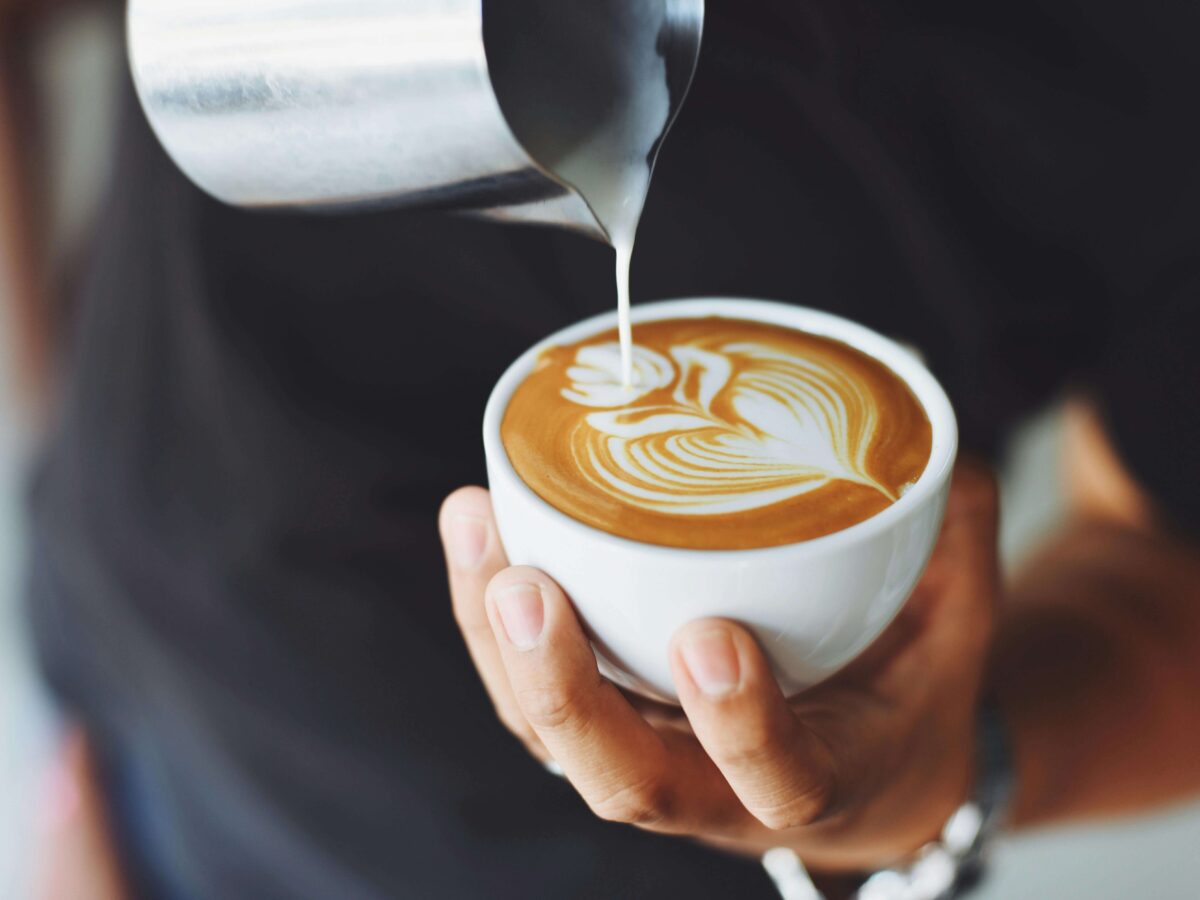
Short post going here to link you nice folks to an article I wrote about latte art for Fresh Cup Magazine.
In it, I talk about whether or not the bitterness of crema is highlighted by latte art, and how we should approach latte art responsibly, using basis from James Hoffman’s videos, and a short interview with Mike Philips.
You can see the entire current issue of Fresh Cuphere, with my article starting on page 48.
Bonus: They chose the goofiest looking picture I sent them for the main image of the article. Also, the one day I had a pro photographer to work with, my latte art was off. Mediocre pours in a national publication for the win!
When I first shifted Bitter Press over to the coffee blog it deserved to be instead of a loose mish-mash of whatever, I had one simple directive: accessible brewing methods that can both improve the coffee that professionals are making themselves at home, and can help introduce new home brewers to fantastic coffee.
I can’t think of a single espresso device that does the job better than the Mypressi Twist. And I mean device. Through most of espresso’s lifespan, it has always come down to a machine. An espresso machine. A hulking mass of steel, boilers, and phallic portafilter protrusions.
A machine this isn’t. The Mypressi Twist is a handheld, trigger activated, goddamn space age ray gun of espresso. In every way, its spherical bulb and twisted handle resembles the utopian future promised by 60s sci-fi writers: a glass dome for every roof, a jetpack on every back, and a portable espresso device in every hand. And why not? For all the talk about semi-commercialness of parts integrated into the low cost of the Rancilio Silvia, why not talk about the semi-commercialness of parts integrated into the Twist for a mere fraction of the cost?
Like most espresso experiences, test-driving a Mypressi Twist is really just an exercise in testing the accuracy of your grinder. I found my experience to be frustrating to a certain extent. When the shots pulled the way I wanted to, they were great, but dialing in an excellent pull took longer than I wanted it too, and when you have to disassemble the entire device and boil new water every shot, it becomes a bit of a chore. But more on that later with some hard data to back it up. Let’s examine the philosophy behind the Mypressi Twist.
By slowing down the espresso process The Mypressi Twist gives you a bit more control over the whole process than you would get in your average espresso experience. Great baristas are taught to dose by basket volume and intermittently weighing the dose to make sure that he or she is on point. With a Mypressi Twist, there’s no reason not to pre-weigh your dose before you grind.
With no boiler system, you have complete control over the temperature of the water that you’re adding to the reservoir. Heat retention seems to be an issue discussed, but without using a thermometer, I found water right off the boil to be adequate for brew temperature. Espresso came out at a drinkable temperature, but still very hot. In my estimations, starting water was around 199-200 degrees Fahrenheit. The important thing, though, is that there’s no temperature swing to account for. The cheaper pro-sumer models of espresso machine tend to have a 10-20 degree temperature swing, and that’s no good for espresso, where every variable matters. Inadvertently, this portable espresso device gives you similar control that a professional barista has with a PID controlled boiler system. Control over brewing variables is the most important issue with coffee preparation. It’s putting means of production into the hands of the masses. We truly have the first socialist espresso device on our hands.
All you need is is to the pair the $150 or so Mypressi Twist and a $250 or so Baratza Virtuoso grinder, and you have a sub-$500 espresso option for home or work. Or heck, get fancy, and put Mypressi on your coffee bar’s coffee menu. The cheapest consumer/commercial hybrid machines you can buy that are worth working with will start you at $600 on their own. It’s expensive, sure, but it’s also accessible in a way that’s hard to describe. Or maybe it’s not.
Half the power of the Mypressi Twist is the strange phenomenon that surrounds it — the power of lowered expectations. Upon first sight, upon first demonstration, there’s no doubt that the Mypressi Twist will raise, well, doubts. It doesn’t seem possible that this fidgety device can prepare solid espresso options. Going into home espresso preparation with low expectations is key. There’s a reason that high-end espresso machines can run up to $20k. And a reason that the Mypressi Twist costs $150-170. The ability to drive professional baristas into full blown shock and awe is the trick that the Mypressi Twist has up it’s sleeves.
The low expectations for a handheld espresso device, and the high delivery and low cost of the Mypressi Twist make it a befuddling brew device, for sure.
And the end product. A beautiful pull of Kenya Thiriku. Fancy Japanese made demitasse found at thrift store. It’s an even two ounce capacity. Shot was fantastically delicious.
With that in mind, let’s take a look at a table full of my collected data. In the week and a half of having the Mypressi Twist at my disposal, I pulled way more shots than documented, but this represents two days worth of data gathering. Previous attempts found that 18 grams of coffee was generally the target weight I wanted to use for evaluation. My first two pulls were at a straight 2 grind setting on the Virtuoso and pulled beautifully and delicious.
Then when time came to repeat the experience, things went a bit awry.
More than anything, this becomes a big ad for the Virtuoso Precisio grinder — one with a micro-adjustment — over it’s predecessor, the Virutoso Plain and Tall.
Other Observations
—Overall build quality is far superior to the original model, which I played with a lot when they first arrived. Plastic is thicker, locking mechanisms tighter, metal heavier. Much better suited to wear and tear.
— The big improvement here is the improved basket design. There’s a slight ridge to it, which is supposed to help pressurize the basket with less than perfect grinds. No way for me to really test it, but I’m assuming it helps.
— There’s now a built-in “shot timer.” Basically, the reservoir top has four different notches, each with a pip numbering *, **, ***, ****. It’s just a little thing, but it’s nice not having to memorize how many shots you’ve pulled with a particular cartridge.
— O-rings. They make the device work, but I had a loose one that I had to swap out for a replacement one. If they don’t fit perfectly, it makes a bit mess. Or just leakes pressurized gas.
— Channeling, and basket size: can be an issue. The basket is narrow and deep, making leveling your dose a bit more of a chore than with a standard 57-58mm basket. This can lead to channeling. Also, not holding the device level can lead to channeling. Making sure you level your dose and hold your Mypressi level will keep the water traveling centered.
Final Take
Does the Mypressi Twist have problems? Yes. But, at the same time, it’s the first espresso device I’m going to recommend to anyone to buy. Hell, I’d recommend it over most entry-level espresso machines, and even some mid-grade hybrids. The potential it holds is great, and the usability and build have never been better.
Personally, having espresso as an option at home creates problems for me. I play around with espresso enough at work, and devoting a half hour to dialing in a great shot doesn’t do my marriage very much good. So sadly, when I return my review model Mypressi, I won’t be rushing out to get one.
As soon as I’m out of a retail situation, however, you bet your ass it’s the first thing I’ll save up to buy.
Today, Sprudge has published some horrific info about the Colombia Coffee of Excellence competition. This is one of the most important stories that’s ever broken in the coffee world, and I have absolutely nothing I can say about it that hasn’t been said.
But something else happened today as well:
This was in response to Tom Colicchio’s new restaurant using Starbucks Via new instant flavored coffees as a companion to a luncheon. Which seemed to be a promotional thing. To which Tom replied, “we use la colombe at Riverpark.”
Mr. Colicchio’s capitalization and grammar seems to a bit Internet Casual, but this factors into the story later. Let’s remember that the only thing he’s capitalized so far is his own name. Mr. White suggests maybe a coffee menu upgrade, like the one at Eleven Madison Park.
Mr. Colicchio then states, “we serve stumptown at craft and Colicchio & sons maybe you should get your facts straight.”
To which Mike White asks, “I’m aware. Why stop there? Serve it at Riverpark too!”
To which Tom lays out:
Wow.
Mr. Colicchio ends it with, “la colombe does a proprietary roast and blend for us we think it is good.”
Now most industry folks will know why Tom Colicchio using La Colombe is something to avoid — Todd Carmichael is a muckraker, a shit-starter (I’ve been recently called a polemicist myself), and has sort of blacklisted himself from the praise train among other industry folks. Also, (debatable, I suppose), Stumptown’s coffee offerings are just a million times better.
But this is the inherent danger in trying to build bridges and create better coffee service in the restaurant industry. Trying to be candid with Tom, and calling him out on a bullshit move (i.e. promoting flavored instant coffee), Mike may have created a tension between coffee and one of the biggest celebrity chefs out there.
Tom’s work on Top Chef has made him a hero of mine. I’ve never tasted his food, but his work as a critic puts him up there with Roger Ebert for me. I’m not a big Ebert reader, but one thing is true between those two men: they have no apologies for stating their well thought out, honest, and straightforward opinions.
That being said (sorry Larry David), Colicchio’s capitalized “Dick” comment is frightening. Is he able to dish out criticisms (pun!) and not choke them down (double entendre!). Has Mike White challenged Tom to better himself, or driven a wedge between these two men?
Does a Twitter insult actually count? What was Tom’s intended tone?
Who knows (intentional period! not a question!).
What I do know is that we need to create a better dialogue between coffee folks and food folks. I do know that I’m really tired of sub-par espresso at the end of a meal, and a beautiful shot would finish every meal perfectly. We don’t need more hostility between coffee and restaurants, but how else are we supposed to engage on a base level? It’s like the game is rigged.
Closing thoughts: how much money does Starbucks have to pay Tom Colicchio to get him to feature flavored instant coffee during a luncheon? As much as Diet Coke?
I’m sorry Tom. That was pretty low. But if we’re going to respect your taste as a judge and critic, you need to separate yourself from corporate shills.
It’s not like Jim Gaffigan and Michael Ian Black give soda recommendations for a living.
Also, I’d clearly like to point out that I’m perfectly in a situation to judge Tom Colicchio’s actions, due to the fact that I am entirely uninformed about the restaurant industry, and have a blog on the Internet. At least we have one final answer from Tom himself:
This isn’t going to be a very good post. In fact, I can tell you right now it’s going to be a terrible post. Absolutely horrific. Undeniably shudder inducing.
And why’s that? Because I performed this experiment on August 17th, and I’m writing this on October 1st. Whoops. Wordpress got broken, and I couldn’t get it fixed — it didn’t want me to upload photos, and that’s the whole dang basis of this dang here gosh darn blog post. Pretty pictures!
But maybe we’ll figure this all out. There’s a chance I might be able to. I can reconstruct these events using the photos I took. Let’s start out first with some theory.
This whole experiment owes it’s genesis to Jesse Kahn, currently of the unfortunately named World Bean (No apologies! It’s cheesy!).
The coffee, coarsely ground, waiting for the water to heat.
One dark eve, sipping on some coffee, Mr. Kahn and I were discussing cold brew methods, and my dislike of them. He then mentioned the fact that a hot bloom on a cold brew might bring out more of the acidity of the coffee, since a lot of those tones turn up in the first forty seconds or so of brewing.
So I stoled that idear. WELL, I told him I was going to steal it. And he seemed okay with that. But I had an even better idea. Why not hot bloom in a Cafe Solo, and then filter it in a V60? It’ll already be pre-filtered of large particles, and there won’t be excess agitation when filtering it through paper.
So here we go!
I wanted to use the Golden Ratio, so we went straight 60 grams and one liter of water. Pretty clever, right? I went for a fairly coarse grind on this sucker. I figured that if it was a twenty-four hour brew time, I could afford a Toddy style coarse grind. This might have been the downfall for this first experiment.
Zeroed out.
And we’re just waiting for that water to hit temp. The whole goal was to hit it with a hot bloom, right? So of course the water has to be hot! I used my Hario Buono kettle to bloom the coffee, and had a liter of cold, filtered water standing by to immediately drown the bloom and try and cool it down. We didn’t want this to be a hot brew. It’s a cold brew, at heart. Which means cold water. Duh.
Time to start that bloom! I think the water temperature was around 200 Fahrenheit, but who really knows anymore? It could have been as high as 204. Sheesh. this article really is sloppy.
Stirring is verboden when it comes to Toddy style, but this ain’t no Toddy. Agitation is the key to extraction with immersion methods, and I wanted to treat this like a hot brew since it was a hot bloom. I think I waited a minute?
No specific bloom weight in mind, just trying to get an even coverage.
Here’s the pseudo-science that we’re basing this off of: coffee has a sort of plateau curve when it comes to extraction. At a certain point, it’s going to level off. Agitation (i.e. stirring) causes a new curve to shoot up off the extraction curve that it was currently on. Make sense? In our (my) attempt to get a solid extraction curve going, we (I) used agitation to promote more extraction!
Now this is pseudoscience for a few reasons. I really have no data that backs this up besides a graph I saw in a Scott Rao book, and my own danged palate. And this is touching on another thing I want to write about in the future: the science and pseudoscience behind coffee brewing. As much as strict science can aid coffee brewing, not everyone can afford a refractometer to measure your extraction levels with ExtractMojo. So you have to use the tools God gave you, and a basic understanding of the underlying scientific principle, even if you can scientifically measure it’s effect. ANYWAY.
Looks like I settled on 159 for the bloom weight. It wasn’t very good coverage, so not only did the stir promote extraction, it also promoted even saturation of all coffee grounds.
Let’s add some water, shall we?
Starting the cold water pour.
Carafe filling up.
One liter, up to the top.
And then it was time for the cold water coverage. It was pretty hard keeping my crappy scale on the right weight, because of the stupid enormous weight and it’s shitty internal whatevers.
A really glorious bloom reaction, some sort of weird half-halted bloom occurring as the cold water mixes in with the hot bloom, truly stunning to watch.
Holy fucking shit was that awesome looking. The bloom was still reacting, even in the cold water. It was super angelic, and beautiful, and man was it appetizing. No idea why.
And for twenty-four hours, or relative thereabouts, it brews.
Then it goes into the fridge in between grapes, English muffins, and some red pop.
Time to filter this sucker.
Twenty four hours later, it was time to get busy.
Rinsing the filter, of course, with cold water. Almost used hot.
Beginning to pour into the filter. Not sure what to expect.
Oh, it’s filling up fast. Annnnd it’s draining sort of slow.
My ingenious plan of using the Cafe Solo as a pre-filter didn’t go as well as I thought it would. It still was a very slow drain due to the particulate suspended in the brew. But I knew it would be worth it, if I just could wait it out.
But man it was a long wait. A series of pouring, waiting, pouring, waiting, trying to be patient, pouring more, waiting more, and sheesh. During round two (not photographed), I tried stirring it up with a chopstick a the very end, and poked a dang hole in the bottom of the filter. Whoops.
This.
Is.
Boring.
Some more shots of it dripping. Yeah, I don’t know.
The finished product. Pretty tasty, but not the best, if I can remember correctly.
And there we have it. It was a bit lacking in brew strength and extraction if I can remember. Just a little too light on the tongue and slightly sour. Kenya Thiriku, by the way. Round two saw me use 80g of coffee and an extra stir after I added all the cold water. It saw much better results.
Sweet, fruity, winey — it was very reminiscent of what the coffee yielded in a hot brew. And chuggable. You could down a glass really easily. Still, the best cold coffee I’ve ever had was just an extra cooled Chemex of an Ethiopia Yirgacheffe. But that usualyl doesn’t stay good after a few hours. You’ve got a peak window to drink that, and this cold brew seemed to be the prescribed method.
So Jesse Kahn: thanks. And instead of trying a control brew with no hot bloom to compare, I’m just going to assume it wouldn’t be as good, because it’s October 1st today, and cold as shit outside.
Still working on an image fix for Wordpress, so pardon the stark text.
Okay, we’ve all been wondering: can food, booze, and an airport really change the face of coffee?
We’re sitting on a precipice here. I’m not one to toot my own horn, but the new Pasadena Intelligentsia is a big deal. Like, a really big deal. And there are two reasons for it: food and booze. Forget about coffee for a moment. The two more universally liked things on the planet are food and booze, and good food and good booze are generally easy to appreciate.
Think on it for a second — you can’t always pass along a siphon brew of a beautiful Kenya to your grandpa and expect him to like it. It’s probably not what he recognizes as coffee. You can, however, give him a nice plate of food and a great beer, and he’ll be able to recognize the difference in a heartbeat.
The goal of the specialty coffee industry is to bring great coffee to as many people as possible. Coffee is already a universal idea, just not in the way we would want it to be. Far too often new coffee establishments open that seem to cater only to those people who already work there. Penny University was an amazing concept, but really their scope was extremely limited. And this is why the Pasadena location is important.
Offering great food, and soon a craft beer and short wine list, Pasadena is a bridge outwards. There’s something great happening on their Yelp! page. Take a look. Nary a one of those reviews is from someone who’s attended for a V60 or siphon or a single origin espresso. These folks are then exposed to great coffee.
And there’s another reason why it’s important, too. The average chef generally doesn’t have a well-developed coffee palate. It’s just not always a priority. But. The average barista generally does have a beer, wine, and food palate. It’s part of the reason why they’re in coffee. They love expansive flavors, and hunting them down. You can always trust a barista to tell you where the best food and spirits in a town are, and even better is the option of the barista serving them to you at his or her own establishment.
In terms of mass appeal and exposure, this Pasadena Intelligentsia is definitely helping crack open the protective shell that specialty coffee has developed in the past few years.
And on that note, let’s jump over the boring Midwest out to LaGuardia airport. There’s something amazing that has popped up. A major company with licenses for a variety of coffee chains and leases in airports has forsaken the familiar for the spectacular, in a risky move that’s part of LaGuardia’s revamped dining options.
World Bean is offering espresso from a Slayer, V60 pour overs, and coffee from Intelligentsia, Eccco, Counter Culture, and others. Their coffee program alone is fantastic enough to welcome great attention, but the fact that it is in an airport is the keystone to this here proclamation: World Bean could single-handedly change the public opinion about specialty coffee.
Far too often, the best chefs ignore the best coffees. It’s an after-thought in their own restaurants. But like all palate-slaves, they’re often intrigued by great coffee, and when given the option, they will hunt it down. So, say, if you’re a world class chef traveling the world and you happen to run through LaGuardia…
Just made a V60 of Finca el Puente for Michael Lomonaco, and pretty much blew his mind. Expect great coffee from the NYC restaurant world… 2:35 PM Sep 3rd via Twitter for iPhone
I have to admit, that line of thinking is a bit of a stretch, but airports are terrible. It’s a never-ending waiting game, and airport kiosks are usually the worst. So if World Bean becomes successful, then every day passengers are constantly exposed to excellent coffee. That’s the beauty. It’s high quality specialty coffee, and you don’t have to convince anyone to come find it. It’ll find you. And if this location is successful and they start to build more across the country…
Well, it might start an entire coffee revolution before we even know it.
The other day, when walking down the street, I caught a whiff of perfume. It was the same scent that my first girlfriend used to wear, a girl I dated on and off from seventh grade through ninth, and smelling the perfume again brought waves of old emotions back. Remembering my first kiss, and really, the first sort of connection I had to another person that evoked some sort of false signals of love.
I get the same way every year when I smell coffee from Yirgacheffe. There’s something so beautiful in those candied fruit and floral aromatics. I was sitting at the bar counter at the Millennium Park Coffee Bar the other day on my day off, and as soon as a batch of coffee was dropped in the Guatemala for a cup of the pour-over coffee of the day, the scents drifted seductively across the brew bar and curled up around in my nostrils. My palms started sweating, and I wondered if my co-worker was going to introduce me to the beautiful new coffee that just arrived in the store, or if I’d have to stumble into some sort of weird pick up line on my own.
“So, you come here often? About once a year, eh? But you’re staying for a few months?” So there’s a chance for a light, late summer romance! Just don’t tell my wife. There are many coffees I anticipate year after year: Finca Santuario in Columbia blew me away last year, Finca La Maravilla in Guatemala is perennially a staff favorite, and coffees from Kenya are undeniably super delicious (especially the Thiriku lots). But none of them hold a candle to the excitement I get when Ethiopia season rolls around.
You see, Yirgacheffe was my first love, as well. Brewing sludgy french roasts in a french press and eating fried, cheese smothered potatoes every morning was the pinnacle of my coffee appreciation for years. And then, one day, a co-worker at the record store suggested that I try an African coffee. So I eschewed geography, and chose a Sumatra coffee, because it was also a dark roast. Plus, who knows where that actually even is? It could have been an African country.
After that fail, a helpful fella at the Broadway Intelli suggested an Ethiopia coffee, and why not try the Yirgacheffe? This would have been 2005, if I remember correctly.
Even back then, in my old subpar auto-drip coffeemaker, the Yirgacheffe was sweet, fruity, floral, and there was something specific that I just couldn’t put my finger on —and that’s when I looked at the bag and made my first connection. Melon rind. The bag had the words “melon rind” in it’s description of the finish, and that’s exactly what I was tasting. Then that was that.
The power that scent has over us is hard to explain or describe. The same way that a perfume can hold sway over your romantic inclinations, the smell of an amazing coffee can get your adrenaline flowing. But there’s something specific, and indescribable about the way that Yirgacheffe smells. And Charles said something about it the other day.
He was speaking to a customer about how the Yirgacheffe micro-region is probably the first coffee that really developed most of its flavors through its terroir. The soil, the climate, the processing — they all add up to unmistakable flavors and aromas: soft lemongrass, candied fruits. And it’s one of the only places in the planet where the coffee is immediately identifiable. Sure certain growing regions contribute to certain flavor profiles — you’d be hard pressed to find a Kenya coffee without that sharp, bright grapefruit acidity — but the flavors from Yirgacheffe are so specific that you can’t help but fall in love all over again.
There are new coffees in my life, and I’m married now, but as humans we’re all slaves to our senses, and I’ll never be able to forget my first girlfriend, and I’ll never be able to forget the love I have for coffees from the Yirgacheffe region of Ethiopia. The power of scent seems to rake up something primal inside.
Here’s the thing, though: my favorite coffees to drink are always coffees from Kenya or Central America. I really enjoy Yirgacheffe coffees, but they’re never my favorite once brewed. So my sense memory is betraying me. But I suppose that carries the metaphor on a bit further, as well, since my relationship with my first girlfriend wasn’t generally a pleasant one with a happy ending.
I suppose this speaks to the concepts of anticipation and memory fairly broadly — when you wait for something, it’s hard not to be even a little disappointed. And when you remember something, you tend to remember only the best parts. I’m not sure what it means overall, but I thought the sentiments were worth sharing.
Yeah, I don’t know why we ever let them write a coffee article either.
There’s a problem I have: before I became a full on coffee nerd, I was working my way into writing as a possible career. That didn’t quite pan out. Turns out, I’m much more useful professionally as a coffee maker than an editor. That doesn’t mean that I haven’t lost my growing passion for the written word.
So I’m left with, now, a deep passion and professional immersion in the world of coffee, while I continue to write and read articles with a fervor. And anytime I can catch a newspaper or magazine article written about coffee? Why, that might just be the conjunction of two worlds. But there’s a problem. Most mainstream outlets really don’t know much about coffee, and instead of educating themselves, they tend to fall to a few horrible cliches to carry their piece instead of in-depth information. So without further ado, the following is a short list of words I’d love to see disappear from articles written about coffee in mainstream outlets.
1. “java”
Java is an island that produces coffee. In the mid-century, it became a marketing stamp and was eventually adopted as an encompassing slang to mean coffee. In the modern day, there is no excuse to interchangeably use java to mean coffee. If the beans didn’t come from the island of Java, then it’s just creating confusion.
2. “buzz”
We get it. Caffeine affects neuro-receptors in the brain and blocks whatevers that make you feel tired and triggers a small release of dopamine. This is just a lazy term to throw in to make the writing more colorful, but it doesn’t really mean anything.
3. “heart-attack inducing,” “heart-stopping”
Look, I understand that espresso has a higher concentration of caffeine, but it won’t give you a heart-attack. Again, this is colorful caffeine language that skews the message. Also? No one who actually likes coffee is really that big of a fan of caffeine. It’s there, sure, but the focus is on the flavors.
4. “bold,” and subsequently, “mild”
These two words are proprietary terms. Starbucks, in an attempt to simplify coffee descriptors for a wide audience, adopted these two terms to easily separate their output into two categories. There are issues with this, though. Bold, at Starbucks, refers to coffees with either a darker roast, or a more in-your-face flavor profile, as in an African coffee with a very bright acidity. Mild is a term used for breakfast blends, but also for their Guatemala, due to its balance. The first issue is that bold as a term incites excitement, and entices people. Mild itself is a dismissive term. People tend, then, to overlook extremely balanced coffees, like a Guatemala, when in fact, coffees from Guatemala tend to be some of my favorites. But the biggest issue here is that these terms are not transferable. You can’t walk into any coffee shop around the world, ask for a bold or a mild coffee, and be handed the same thing. The terms are subjective, and empty. And they are proprietary. They have no business being in a coffee article.
5. “grande-venti-mocha-frappa-cappa-choochoo”
It’s 2010. We get it. No need for complicated, customized drink beverage name jokes. They’ve all been made.
6. “crushing the beans”
This is just a pet-peeve. An attempt to get more colorful language into the piece, it is just sort of distracting and vulgar. It’s called a grinder; it is grinding the beans. Crushing makes it sound like the beans are being smashed to death. It’s a little more delicate.
7. “jolt”
See: “buzz.”
8. “jive,” “jazz”
See: “buzz,” but with icky racial undertones that stem from our post-WWII pop culture economy.
Ah yes. There are many ways in which this word is used. The first? Backlash. Folks who like things the way they like them and no other are pretty wary of anyone who might have a strange penchant for obscure mid-70s LA rock and facial hair, and the term “hipster” is meant to be a barb in our sides. Folks who are willfully ignorant of alternative pop culture might throw out the term in the same way they would for “cave troll” — they’re not sure what it is, exactly, they may have seen one as a kid, and they know for sure it refers to a monstrous subset of creature with strange mores and an alien consciousness. But let’s face it: are we still referring to the black clad, poetry-sprewing, drug-addled wanna be beats of the 60s, or are we going cutoff denim shorts, brunchin’ in Williamsburg? Either way, does the term “hipster” really mean anything? It’s been adopted into our lexicon. It’s become part of our vernacular in a recognizable way. But it’s just another way of stereotyping, and it distracts from the meat of the story — that would be the coffee, and the preparation methods employed by said “hipster.”
10. “spill the beans”
Ugh. Really? Puns? There is so much rich information available out there, do we really need to get chummy and bland in order to rope in the reader?
The phrase was apparently coined in the 1840s. I think it’s done it’s time.
When it gets down to it, a lot of these are just picky little pieces of text. But the harm they do to the coffee world is more subtle. The general public is heading into a coffee awakening. Most larger cities now have a growing population of cafes and coffee bars that are pushing the boundaries of coffee, and the word is getting out.
Relying on snappy cliches just puts the message out to the reader that your publication A) assumes a certain level of intelligence of its reader, or B) purports that there’s really only so much you need to know about coffee, and quippy copy trumps all.
In my opinion, the best possible tool in the Specialty Coffee industry isn’t a refractometer, but rather the media. No matter how hard a roastery or coffee bar works to perfect their coffee, if the message isn’t getting out to customers, it doesn’t really mean much. Phrases like “cup o’ joe” homogenize the idea that a cup of coffee is a cup of coffee, while most people doing great work in coffee recognize the extreme difference that can be in the cup from place to place. So why are we letting traditional media control the message?
It’s 2010 — we’re immersed in new technologies and social media isn’t a hot new trend anymore: it’s a day-to-day basic standard of living. Twitter alone has connected me to hundreds of excellent coffee people, and in turn, to their own blogs and journals, where I’ve made some of my best discoveries about coffee yet.
This isn’t quite a radical’s manifesto. I’m not suggesting a complete blacklisting of newspapers and magazines (not yet, at least), but I feel that coffee folks need to immerse themselves deeper into the interviews and and articles being written about them. There’s a simple first step that I recommend. As soon as the interview is over, just lean in and say to the interviewer:
When I first brought home my Virtuoso grinder, I was replacing a KitchenAid ProLine that I’d been upgraded to when I lost a spring on my previous KitchenAid grinder, and the customer service lady misunderstood me and thought it was broken. It was a fine grinder that served me well, but I was ready to step my game up. After months of using one in the store for our Chemex and Cafe Solos, I decided to go for the Baratza Virtuoso grinder.
But I found something out when I got home. I found that I could not get a grind setting that brewed a delicious cup, and reacted the way I was used to in the cone — the coffee bed would rise quickly, or drain slowly. Instead, I found the water would pass through the grounds quite quickly, giving me an overall brew time of less than a minute. And thus began my quest for discovering the perfect brew specs for the V60.
At first I blamed the grinder. I had since adopted brewing on a scale, I had played around with finer grinds and a lower dose, I had tried a variety of coffees. Nothing seemed to work. Sometimes I had better results with my Hario Skerton hand grinder, so I tried finding out what was wrong with the Virtuoso. I found a good amount of information. First? A laser analysis of the particle distribution:
This is pretty freaking awesome.
What this shows is a detailed analysis of particle size. The spikes represent a higher occurance, and the fact that the spikes are so high at medium and coarse means that a good deal of the particles are the desired size. This was reassuring.
This was not. Irish cupping savant and scientific researcher David Walsh had some issues when he tested the Baratza lineup. First, he found that the Maestro series could not grind a good espresso size. Next, he found that the Virtuoso could not grind a good filter size. BUT! He found that the Maestro filter grind was superb, and the Virtuoso espresso grind was superb, which meant that I had ended up with the wrong grinder, apparently.
I was heartbroken. The Virtuoso was a birthday present from my wife and sister in law, and working in a coffee bar, big equipment purchases, even with a discount, are still big purchases and are not to be taken lightly. But I decided not to worry. I got on some forums, did some research, and put out some feelers. Maybe someone had a good idea of what to do with my grinder. So I posted something on a forum asking if anyone else was having issues with the water passing through the coffee too quickly when using a Virtuoso, and to my surprise, Kyra from Baratza contacted me shortly.
Look at these two, all buddy-buddy.
She said that many people had had better luck using the Maestro Plus for drip brewing, Hario V60 specifically, and that she’d be willing to send one out for me to try. I was ecstatic. A new grinder would solve all my troubles.
When I was first conceiving this post, I thought that it would be a showdown between the two grinders. I had my hypothesis. I had information to back it. What I didn’t expect to get, however, was a humbling experience that forced me to re-evaluate home brewing.
When the Maestro Plus arrived, I found I was having similar problems with it. Too fine and it reacted the way I wanted to in the cone, but it was terribly over-extracted and bitter. Too coarse and it meant that the flavor profile was better, but that it was generally under-extracted and flowing through too quickly. That happy medium was hard to pin down.
Now, at the coffee bar, we’ve been brewing all coffees-of-the-day to order on Hario V60s since October. This means I have literally made thousands of cups on the Hario V60. Thousands. So I was pretty confident that I knew what I was doing when it came to brewing at home. With the Mahlkönig Guatemala grinder at work, the bed rises extremely fast and drains nice and slow, allowing for more of an immersion time in the brew. But I hadn’t thought, until I pit the two grinders against each other, that maybe I had some learning to do.
I ran every variable I could. I cupped all the water I had available at home — refrigerator built in filter, Brita filter, and even Chicago city tap water — against the water in store. I found that the Brita water had the best profile. I brought grind samples into work, and tested their bed raising ability against the Guatemala. And at work, surprisingly they performed much better in this regard. Which was puzzling, but the first part of the solution to this strange problem.
A test brew using the Maestro Plus grind at home. The bed isn’t rising like I was used to, and the coffee passed through a little quicker than I wanted it to. The end result was under-extracted.
Back home, I took a look at my overall specs. I was using 250mL of water, thirty seconds off boil, 16g of coffee, with about a forty second pour and a thirty to forty second drip time. I started looking around for other people’s methods. The problem was that not many people detailed their specs. They showed their methods, but they gave a range of dose, not a specific dose. And that’s when I realized something stupid. I wasn’t checking my water temperature. The water at work sits right at 200F-202F. At home, I was probably brewing at closer to 208F-211F. Maybe the hotter water caused it to travel faster through the coffee.
I also remembered one other thing — when I received coffee from David Walsh’s coffee exchange, I connected with Aaron of Brown Coffee Co on Twitter, and saw that he gave me the specs he was using for the coffee on his V60. So I examined them:
18g; 11 fl oz of water at 204F to yield 10 fl oz over 2:30 using Hario V60 + Buono w/ Barismo gicleur.
I started to do some other math too. I was brewing at 250mL at home, because that’s what my mug could hold. At work, however, the smallest we brew is a 300mL yield, which means we’re using anywhere from 315mL-330mL of water to brew. The 11oz that Aaron suggested was equivalent to about 325mL. Stupid me. I had been brewing in miniature. I started taking the temperature of my water too. Cooler temperature and larger brew size meant that I had more time to let the bed raise while I was pouring, and that it seemed to raise quicker and more steadily, and drain slower like I was used to. I had hit upon something.It wasn’t reacting the same way at work, but then again, I was using different specs, and realizing that there are other ways to make coffee taste great, and the coffee was starting to taste great.
A brew test using the new specs, the Virtuoso, and a water transfer — more on that later. The end result, by the way, was quite tasty.
But that’s not the end. In my studies, I found plenty of other amazing brew methods from people like Nick Cho, Barismo, and other great coffee places across the country. There are so many other methods of brewing on the V60, that it’s hard to say how the device is supposed to perform versus how to best get it to perform. And even though I was pretty confident in my V60 skills, I had been the biggest issue as to why my coffee wasn’t brewing the way I thought it should. It was never the grinder. One serving of humble pie, please.
However, there does seem to be one small aspect in which I’ve been vilified. While I was at my wife’s parents’ lake house last weekend, I was brewing coffee on the V60, and noticed that the bed was rising crazy fast and draining extremely slow. It was strange. I thought I’d gotten over the fact that it wasn’t going to react this way, and that a lower bed in a brew was not the issue I thought it was. I knew for sure, now, that temperature wasn’t really the issue — I hadn’t brought a thermometer, and had poured about thirty seconds off of boiling. So I looked at the cook top I was using: ceramic electric. At home I have a gas range. A little voice echoed in my head, something that Intelligentsia’s Quality Control mastermind Jesse Crouse had mentioned to me when I was experimenting with siphon brewing:
Try to imagine what is happening when you have a burner on as oppose to the beam heater. Where is the point of contact for the heat in each scenario? How does an oven vary from a stovetop?
Radiant heat. Radiant heat travels. Which means at home, on the gas range, the entire Buono kettle was being heated, while at the lake house, I was using a ceramic top with an electric coil underneath, which meant that the water was being heated in the kettle through the bottom of the kettle, and the top part of the kettle wasn’t being heated the same way at all. At work, too, we use a hot water tower into a kettle, meaning that it’s not being heated either.
At home, I ran tests boiling in one kettle, and then transferring it into the Buono before I poured, measuring the temperature in the Buono and letting it sit until it hit 204F. Sure enough, the bed raised quicker, drained nice and slow, and the coffee reacted the way I wanted it to before I stopped caring how the coffee reacted during the pour.
The only problem is, why? Why would a hotter kettle affect this? It’s not an easy to grasp scientific principle, but then again, who cares? I’ve got the tastiest V60s greeting me every morning, and my methodology is finally solid.
The coffee I am drinking while writing this post.
Oh yeah, and the Virtuoso against the Maestro Plus? I’ll put my money on the Virtuoso. For some reason, I just couldn’t get as tasty of a cup out of the Maestro Plus, even though it looks like it has a better particle distribution in a drip grind setting.
Samples from Virtuoso and Maestro plus. From left to right: finer drip grind from Virtuoso, coarser drip grind from Virtuoso, finer drip grind from Maestro Plus, coarser drip grind from Maestro Plus.
In the video, you can see that my new specs with the Virtuoso only have about fifteen extra seconds of brew time, and that the bed rising and dripping isn’t really all that different. The Virtuoso is also just a better build, and can handle basic espresso style grinds, suitable for an eventual Mypressi Twist or other pseudo espresso device. The Maestro Plus is still a fantastic machine, and I’m sure that I could eventually make just as tasty a cup on it as I could the Virtuoso, but I realized this whole thing isn’t about letting the equipment carry the brew — in the end, it’s your math versus your methodology. But I guess maybe a flow-restrictor might be nice…
Or a controlled water dispersion system, like the LB-1 or Uber boiler…
I’m not particularly proud or fond of the last two posts that I have up here, but I think they represent what happens when you let your judgment slide and you just can’t let a comment go, and it’s something I should leave up to remind myself of that fact. Even though I want to just leave it all in the dust, I’ve got another itch to scratch, and it shames me to think that this kernel of thought comes from Todd Carmichael, once again.
In one of his latest posts, “chasing the dragon with slow-brew apparati” is used as a rallying phrase. Todd’s approach to thinking of coffee heavily focuses on espresso, and he’s been quite clear about how he views brewed coffee. But here’s the problem with this: he’s got it all turned around.
Chasing the dragon? It’s firstly a reference to a particular way to smoke heroin. In context, here, it’s used as a reference as someone trying to attain the unattainable — after that first high, you’re never able to replicate it exactly the same way, and you’re forever attempting to achieve something just beyond your grasp in the cup.
See, Todd’s bias against brewed coffee has him throwing insults at what I’m assuming are various heat sources for siphon brewing — halogen bulbs, butane burners, etc. It’s all very science lab and showy, heroin cooking reference, bada bing bada boom. The truth is, however, that espresso is extremely finicky and vulnerable and if we wanted to make Todd’s reference stick, we’d have to shift it’s focus back to espresso from brewed methods.
It’s not very hard to see. Espresso is the product of a pressurized hot water being forced through a very fine ground coffee that’s been packed into a tight puck. It’s highly concentrated and by nature very volatile. Ask anybody (including Todd Carmichael) what’s necessary for good espresso preparation. They’ll tell you two things: an amazing espresso machine, and an amazing espresso grinder. Not only are these two pieces of equipment expensive, but they require hours and hours of practice and training to get consistent, delicious espresso from them.
In order to get espresso to taste good, you have to play with every single variable available: temperature, grind, volume, tamp pressure, dose, and to an extent, the pressure on the espresso machine (though that’s a very recent development). And even then, once you have the coffee dialed in correctly, you have to keep an eye on your shots — a slight variance in humidity will throw the whole thing off and you’ll need to re-adjust.
This is part of the reality of espresso. And what really got me thinking on this is an amount of time spent reading the forums on Home Barista. These folks are taking home brewing for espresso to levels of extreme time, care, and money. Way out of my league. That’s why I work in a coffee shop. But more than anything, these folks are willing to spend hundreds of dollars on attachments for their machines, new parts for their grinders, or other auxiliary equipment. There’s nothing wrong with that, but it seems that the idea that espresso is the golden child of the coffee world is a rather backwards way of looking at it. It’s the problem child of the coffee world. When you get it to behave, it’s the most amazingly rewarding sense of personal achievement and deliciously sweet, but there’s a good chance that it’ll be an extreme pain in your ass most of the time.
Then there’s the case for so called “slow-brew” coffee, which, really, is just an absolute insult to put slow in front of it as an adjective. Calling it “slow-brew” coffee makes it sound like we’re being slow on purpose. Here’s what I’d like to say: How long does it take to roast a turkey? Can’t you, say, dissect it and throw it over a charcoal grill, piece by piece, and cook it faster? Sure, but it’s not necessarily Thanksgiving anymore.
And brewed coffee isn’t a savior saint either. Ask me about my absolute insane pursuit of the perfect cup from my Hario V60 dripper, and the amount of time I’ve spent pitting different grinders against each other for it.
The truth is? All coffee, to some degree, is chasing the dragon. There’s no such thing as the perfect cup. We may have imagined it once, or remembered it wrong, but the best coffee is always unattainable, be it pour-over drip, immersion, or espresso.
Let’s examine immersion brewing, say, using a press pot. It’s simple, right? Grind coffee coarse, add to pot. Add water to coffee, stir, press. We still have the entire same set of parameters that we have with espresso. Grind, dose, water temperature, agitation. It’s inescapable. Any matter of those variables, linked together in a certain way, can achieve the same extraction rate and tasty cup in the finish.
So why fight for either one? What case is there to be made except that coffee is SERIOUS. BUSINESS. There are those that care about investing their time and energy into preparing it, there are those that love being on the other side of the counter and just enjoying the end result, and there are those that enjoy the occasional espresso beverage or don’t like drinking coffee at all.
I’ve been wrong before in my life. Like a lot. I mean A LOT a lot. And the one thing I’ve learned from all of that is that anyone who discounts anything based on pre-conceived notions, stereotypes, or just based on the principle is going to end up being wrong.
We all have our preferences, and as soon as anyone decides that their preferences are law, everyone loses.
Todd Carmichael’s blog posts get me worked up inside. To an unhealthy extent. I get really embarrassed about it. And I also get pretty crazy. I’ve had to work pretty hard to keep this blog post on track and keep it from fighting his articles, point by point. But the guy has his viewpoint, and he’s completely entitled to his preferences. Since I don’t agree with them, and since he doesn’t seem to want to come around and play nice, I have one option left:
Don’t read the blog posts. It’s pretty simple. I make the choice every time I open the Esquire food blog to see if he has a new piece. The definition of crazy is doing the same procedure over and over again and expecting a new result.
It might not be, and might not ever have been, worth getting crazy.
On a Monday night, the last thing I expected to see in my inbox was an email from Todd Carmichael, one that began with this paragraph:
Before I become completely ostracized there are number of very important topics in roasting that are never properly discussed on blogs like yours. I have 9 of them, and this is the first. Would you mind discussing it?
Then he went into point one of nine, which I won’t reprint here, but can say that it may be a valid concern about gas roasting. I figured that hey, maybe he did want to pursue an honest to god back and forth discussion, and participate in the overall pursuit of great coffee. So I sent him an email back, detailing what would be needed for me (or anyone) to take him seriously, and consider this first, valid point that he had sent along.
Hi Todd,
Sounds like you have some valid points here about roasting.
But before I could even consider taking any ideas or opinions or thoughts you might have seriously, I’ve got a simple three step program.
1. Acknowledge that the articles you wrote for the Esquire blog are wrong — not wrong in content or opinion, but wrong in the sense that the tone and attitude delivered a piece of writing that helps no one. So far, all it’s done is angered the coffee community — the entire coffee community — and discredit your entire life’s work in coffee. You’ve been around horn, you were there at the big bang of American coffee. You’ve got knowledge to share, but this isn’t the way to do it.
2. Apologize publicly for being such an ass in those last two posts. Write a blog post about how you got caught up in the mess, you said things in a way to get a reaction, and that you really didn’t mean to be so stupidly hurtful in your last post.
3. Join the discussion that everyone else is having, as an active participant and not a hate-spewing outsider. We’re all grouping together, forming a loose coalition of knowledge sharing, and we’re doing it in a respectful way. A lot of youngsters — like me — missed out on most second wave coffee establishments. It’s a shame. The third wave of coffee is a derivative movement, and that’s where me and my peers are starting from. Without knowledge of what came before to inform my actions, I’m just a derivative of a derivative. We want to hear what you have to say, and the email you sent has an extremely valid idea behind it. I don’t roast. I just make coffee in a coffee shop. So that’s an issue I can’t directly comment on, but it’s an idea to be considered and addressed.
Problem is, Todd, no one is willing to discuss these things with you. You already walked out into where we live, dropped trou, and took a shit all over our stuff. A crazy, horrible, runny shit. That hurts. Now, if some guy walked into your house, pooped on your cat, and then said, “hey, I have a theory about the way people scoop cat litter,” you’re not going to be very willing to discuss cat litter with them, are you?
Just consider it.
-Jesse
Lo and behold, Todd replied back — twice.
Thanks.
I guess the topic isn’t that important to you. I see.
What I will say is that indeed, we all work hard, and I will continue to do so as I hope you do. Bond away.
Appologize? For my way of thinking and expressing myself. This is America.
I tried.
T
The next email goes into detail about his issue that he wants to discuss, but instead of coming off as a concern he wanted to discuss, it turns out that the whole thing was a “gotcha” attempt all along. Apparently, everyone is roasting coffee wrong. Which I think sums up everything I really need to know about Todd Carmichael. I won’t reprint his full point here, because I promised I wouldn’t discuss it unless he followed my three criteria.
I don’t like Internet squabbles. I think they’re not very representative of people’s true personalities, and can come off as more combatant than they need to be. This is something that most people learned after one or two bad experiences when they first started commenting on Internet boards. And yet, there are the trolls — people with no lives who want to contribute nothing to the conversation except their own inflated ego. And I think we all know exactly where Todd Carmichael resides.